Reports, Not Revenue
The marketing decisions your business keeps skipping – and what they cost
The reports have never looked better. The revenue hasn't moved. Most businesses with a marketing problem have an upstream decision problem: the decisions nobody made before the marketing started. This book names them, explains why they get avoided, and gives you the tools to make them.
Paperback · 329 pages · English · Also at bol.com, Amazon and Barnes & Noble
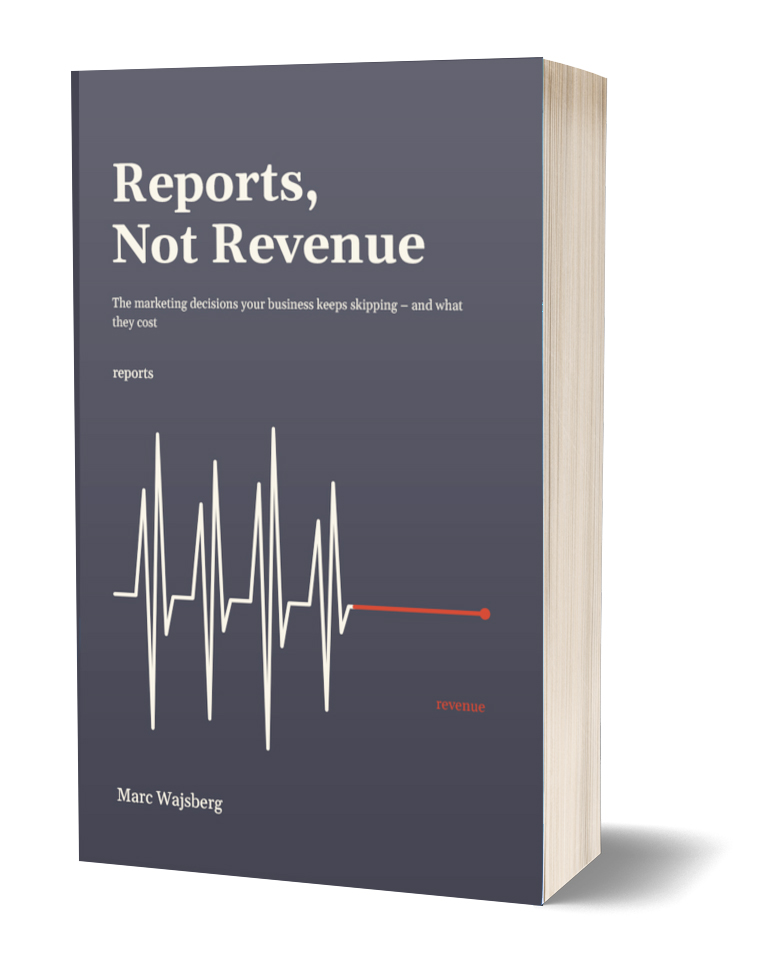
The problem is rarely the marketing. It is the decision that was never made before the marketing started.
If you recognise any of these, this book was written for you:
- You have agencies or had them. You have campaigns running. But nobody gives you a straight answer about what's actually working.
- You've redesigned the website, launched new campaigns, and hired people. The pipeline still doesn't reflect the effort.
- Your sales team keeps rewriting the company story for every prospect because nobody has defined it clearly enough to use consistently.
- You measure marketing by activity: posts published, clicks generated, reports filed. But you can't connect any of it to revenue.
These are not campaign problems. They are upstream decision problems. Who the business is actually for. What it wants to be known for. What it is selling in a form a buyer can evaluate in sixty seconds. What proof is needed before trust forms.
None of those decisions are technically difficult. Most business owners understand them quickly when they see them laid out. What this book also addresses is the harder question: why these decisions get avoided, and what the avoidance costs.
After reading, you will be able to: define your best-fit buyer, state your positioning in one sentence, shape an offer a buyer can evaluate in sixty seconds, and demand revenue-grade measurement from any agency or team.
If your marketing is genuinely working, this book will irritate you. Few readers report being irritated.
Bring the book into your next management meeting.
Two working tools from the book, free, no email address required. Use them to find out where your own upstream decisions stand before you read a single chapter.
Fifteen commercial decisions on one printable page, with columns for Resolved, Owner and Deadline. Work through it in one session with your senior team. Where the answer is unclear, or the team disagrees, you have found a decision worth making. Each row points to the chapter that covers it.
Download the audit sheetFive yes-or-no questions, each on a different upstream decision. A plain result: which are resolved, which aren't, and which chapter to read. No score to chase, no proposal attached.
Take the five questionsTwenty chapters. One decision per chapter.
Each chapter is built around one commercial decision. Not theory. Not framework. The decision, what it costs when it stays unresolved, and what making it clearly looks like in practice. The first six below; the full contents underneath.
Marketing arrives as spend, so it gets judged as spend. This chapter resets that. Marketing as the discipline of making it easier for the right buyer to find you, trust you, and choose you, at a cost the business can defend.
Too large to wing it, too small to spend badly for years. The structural exposure of the middle, why the same mistakes keep producing the same drain, and why capable people produce weak marketing when upstream decisions stay unresolved.
Buyers are not waiting to be dazzled. They are making sensible decisions with limited time, partial information, and uneven attention. The four forces that determine whether they choose you, and which one is most likely breaking down in your business.
Why jumping from problem to product without explaining the causal logic asks the buyer to trust without giving them a reason to believe. The mechanism that makes a message land, and why proof without mechanism lands as noise.
Most businesses are willing to grow. Far fewer are willing to choose where that growth should come from. Why refusing to choose a primary segment is itself a commercial decision, and why it is usually an expensive one.
Many businesses can describe what they do. Few can explain why a specific buyer should choose them over a credible alternative. The place you want to occupy in the buyer's mind relative to actual alternatives, and how to own it without overclaiming.
Chapters 7 to 20
Sometimes the problem is not the message, the positioning, the offer, the creative, the targeting, or the budget. It is the category itself. What to do when the frame the buyer uses to evaluate you is working against you.
Capable businesses are often structurally hard to buy from. The elements that make an offer easier to evaluate, easier to justify internally, and easier to close, without reducing price or changing the product.
Once audience, positioning, and offer are clear, the practical question becomes: what do you say first, second, and third? The sequence that reduces doubt, builds belief, and moves the buyer toward a decision without feeling like a pitch.
Channel choice is uniquely vulnerable to fashion, internal politics, and the wrong comparison. Demand-capture versus demand-generation. Why blending branded and non-branded traffic in a single report hides a weak acquisition campaign for months.
Too many websites behave like polite corporate leaflets. What a website must do to convert a visitor who arrives with genuine intent but no prior familiarity, and the specific structural failures that make most sites lose buyers they could have kept.
Most businesses now accept they need content. That has not solved much. The difference between a content calendar and a content system that produces commercial results, and why outsourcing content before finding your voice makes it worse.
What paid acquisition can and cannot do. How to evaluate whether your campaigns are actually producing new customers, or recycling brand awareness through a dashboard that has no incentive to show you the difference.
Most companies now have more data than they know how to use. Dashboards multiply. Confidence does not follow. The three numbers that most reliably predict whether marketing is moving the business forward, and how to build reporting that decides rather than decorates.
For years, visibility meant ranking on Google. A growing share of decisions now begins with a question posed to an AI tool, a recommendation from an algorithm, or a search inside a community. How to be present where buyers actually form their opinions now.
AEO is not a technical discipline. It is the upstream work of clear positioning, specific proof and structured content, applied to a new environment where answer engines increasingly stand between buyer and brand. What to do and in what order.
The right response to the previous chapters is not a full reorganisation, a dozen new channels, and a massive content calendar. It is a sequence. What to do in the first 90 days, in what order, and why the order matters more than the volume.
Agencies, freelancers, an internal hire, or you. The question is not who executes but who carries the commercial responsibility. How to divide ownership so the thinking stays inside the business and the execution can be bought safely.
You do not need to learn the tools to check the work. The verification questions that expose weak technical delivery in minutes, and the reporting standards you are entitled to demand from anyone you pay.
The chapter the book closes on. Most owners know what needs to change. Acting on it requires choosing, and choosing is uncomfortable. Why vagueness survives, what it costs, and what clarity asks of you.
The most common outcome I have observed across thirty years of this work is not that the business fails to understand what needs to change. It is that the business fails to act on what it already knows.
I have sat across tables from hundreds of business owners. I have laid out the diagnosis. I have shown the data. I have explained the cost of the current path and the mechanics of a better one. In many of those meetings, the owner nods. They agree. They say the right things. They leave the room with a clear plan and good intentions.
And then nothing happens.
Not because they forgot. Not because they disagreed. Because acting on the plan required doing something uncomfortable. It required choosing one audience and accepting that others would receive less attention. It required rewriting a homepage the founder had personally approved two years ago. It required telling an agency that the reporting was inadequate.
Each of those actions is small. None is dramatic. But each one requires a form of courage that is rarely named in business books: the courage to be clear when vagueness is more comfortable.
Vagueness survives because it avoids conflict. If the positioning is broad, nobody on the leadership team has to argue about which segment matters most. If the measurement is loose, nobody has to face a number that proves their favourite activity is not working.
Vagueness is a conflict-avoidance strategy dressed as professional caution. The cost is not visible on any single day. It accumulates.
"You have really mastered marketing. So much of what you write rings true in my own experience."
Edwin Birnbaum, CEO Clarity Advisers, former Managing Director Carrefour Belgium · writes the forewordThis book has a specific reader in mind.
It is not a general marketing manual. It is written for one specific situation.
- You lead or own a mid-sized business with real commercial ambition
- You have marketing activity but doubt the foundation underneath it
- You've been burned by agencies or consultants who produced activity without results
- You want a framework you can apply yourself, not a dependency on external suppliers
- You measure success in qualified pipeline and margin, not reach or followers
- You want to understand marketing well enough to govern it, not just fund it
- You're looking for social media tactics, growth hacks, or channel playbooks
- You're pre-revenue and haven't yet proven your offer in real conversations
- You want reassurance that what you're already doing is correct
- You expect a book to replace the decision-making that only you can do
- You define marketing success as brand awareness or content volume
"Over the course of my career, I've come across plenty of marketing specialists. Marc is the first who actually sounds like a businessman, not a vague consultant full of empty talk."
Philippe Criel, CFO Centre BelgiumOrder your copy.
Published and available now as a paperback. Direct from the author in Belgium, or from the bookshop nearest you.
VAT and shipping included. Ships within 2 working days. Pay by Bancontact or card, securely through Stripe.
Order directCopies for your management team: order 5 or more with one invoice at the same price — email [email protected].
Same paperback, priced and shipped by the retailer. Choose the store nearest you.
- Belgium & Netherlands bol.com Amazon.com.be Amazon.nl Direct from the author ships in 2 working days. bol.com currently shows a longer lead time — check before ordering.
- France & Italy Amazon.fr Amazon.it
- United States & Canada Amazon.com Barnes & Noble
- Everywhere else Amazon.com
Paperback · 329 pages · English · ISBN 9789090425511 · Clixreclame, Knokke-Heist
The book gives you the decisions.
The diagnostic makes them, for your business, with you in the room.
If the book describes your situation, the Commercial Immersion Diagnostic is the shortest route from reading to deciding: one engagement, a written read on where your commercial logic breaks, and a prioritised 90-day roadmap. €2.900, fixed, no retainer required.
Start the intake